OpenAI Drops a 'New Deal' for AI — Then Someone Firebombed Altman's House
TL;DR
OpenAI released a 13-page policy document titled “Industrial Policy for the Intelligence Age” proposing robot taxes, a national public wealth fund, and government-backed 4-day workweeks. Days later, a 20-year-old was arrested for throwing a Molotov cocktail at CEO Sam Altman’s San Francisco home and threatening to burn down OpenAI’s headquarters. The collision of sweeping policy ambition and physical violence captures the raw tension around AI right now.
What Happened
On April 6, OpenAI published its most aggressive policy position yet — a blueprint comparing the current AI moment to the Progressive Era and FDR’s New Deal. The 13-page paper proposes shifting the tax burden from labor to capital, creating a nationally managed wealth fund seeded by AI companies, and piloting 32-hour workweeks at full pay. Altman told Axios the proposals are a starting point, not a prescription.
The document arrived on the same day The New Yorker published a lengthy investigation questioning Altman’s trustworthiness on safety issues. Critics were quick to note the timing. Carnegie Endowment scholar Anton Leicht called the paper “comms work to provide cover for regulatory nihilism.” Others pointed out that a company valued at $852 billion calling for taxes on its own technology is, at minimum, an unusual move.
Then on April 10, at roughly 3:45 a.m., a 20-year-old man threw an incendiary device at Altman’s Russian Hill home. Security guards extinguished the fire on an exterior gate. The suspect later showed up at OpenAI’s headquarters threatening arson before being arrested by SFPD. No one was hurt.
Altman responded with a blog post sharing a photo of his family, writing that he had “underestimated the power of words and narratives” and calling for de-escalation across the industry.
The Numbers
| Metric | Value |
|---|---|
| Policy document length | 13 pages |
| OpenAI valuation | $852 billion |
| Recent funding round | $110 billion |
| Proposed workweek | 32 hours (4-day) at full pay |
| Americans concerned about AI | 80% (Quinnipiac poll) |
| Believe AI does more harm than good | 55% |
| Think AI will reduce jobs | 70% |
| Weekly users in India alone | 100+ million |
| White-collar payroll contraction | 29 consecutive months |
The Proposals at a Glance
Key Details
The Policy Proposals:
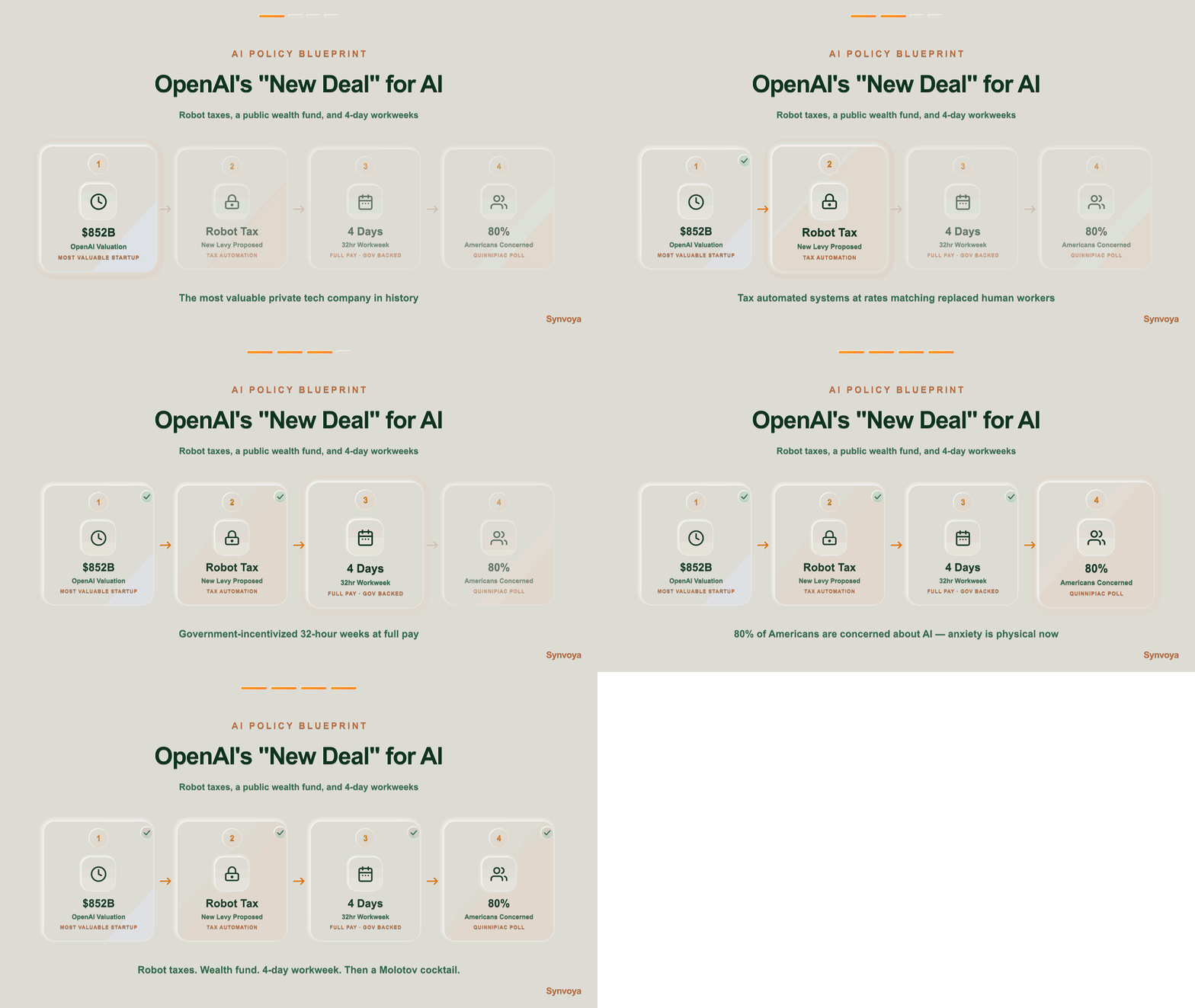
- Robot Tax — Automated systems taxed at rates comparable to replaced human workers
- Public Wealth Fund — Nationally managed fund giving every citizen a stake in AI growth, modeled on Alaska’s Permanent Fund
- 4-Day Workweek — Government-incentivized 32-hour weeks, framing reduced hours as an “efficiency dividend”
- Auto-Triggering Safety Nets — Benefits expand automatically when AI displacement metrics hit preset thresholds
- AI as a Right — Access treated as foundational infrastructure, like electricity or internet
- Containment Playbooks — Government coordination plans for scenarios where dangerous AI systems can’t be easily recalled
The Attack:
- Suspect: Daniel Alejandro Moreno-Gama, 20 years old
- Charges: Attempted murder, arson, possession of incendiary device
- FBI is aware and working with SFPD
- Second security incident at OpenAI in recent months — offices were locked down in November after threats from an anti-AI activist
Why It Matters
OpenAI is the most valuable private tech company in history, and it just published a paper telling the government to tax the thing it sells. Whether that’s genuine concern or strategic positioning ahead of an IPO, the proposals are now part of the policy conversation. The public wealth fund concept alone would represent a fundamental shift in how AI-generated prosperity is distributed.
But the Molotov cocktail attack exposes the other side of this equation. Public anxiety around AI isn’t confined to polling data — it’s manifesting physically. An NBC News poll found AI is viewed less favorably than ICE. White-collar payrolls have contracted for 29 straight months. The gap between AI’s promises and people’s lived experience is widening, and that tension is becoming dangerous.
The political path for any of these proposals is steep. The Trump administration has shown little appetite for raising corporate taxes or imposing new regulatory burdens on AI. OpenAI plans to open a policy workshop in Washington in May to continue the conversation, but converting a 13-page thought experiment into legislation will require more than good intentions from the company building the disruption.
Follow Synvoya for daily AI news summaries — quick reads, no fluff.