The 2026 AI Report Card Is In — 12 Stories That Define Where We Are
TL;DR
Stanford’s 2026 AI Index Report dropped today — 400+ pages, the most comprehensive annual snapshot of AI on the planet. The headline: AI is sprinting and the rest of us are still tying our shoes. China has nearly erased the US lead. Young software developers are losing jobs. AI adopted faster than the PC or internet. And the companies building the most powerful models are sharing less about how they work than ever before. Here are all 12 stories.
GEOPOLITICS · The US-China Gap Has Evaporated
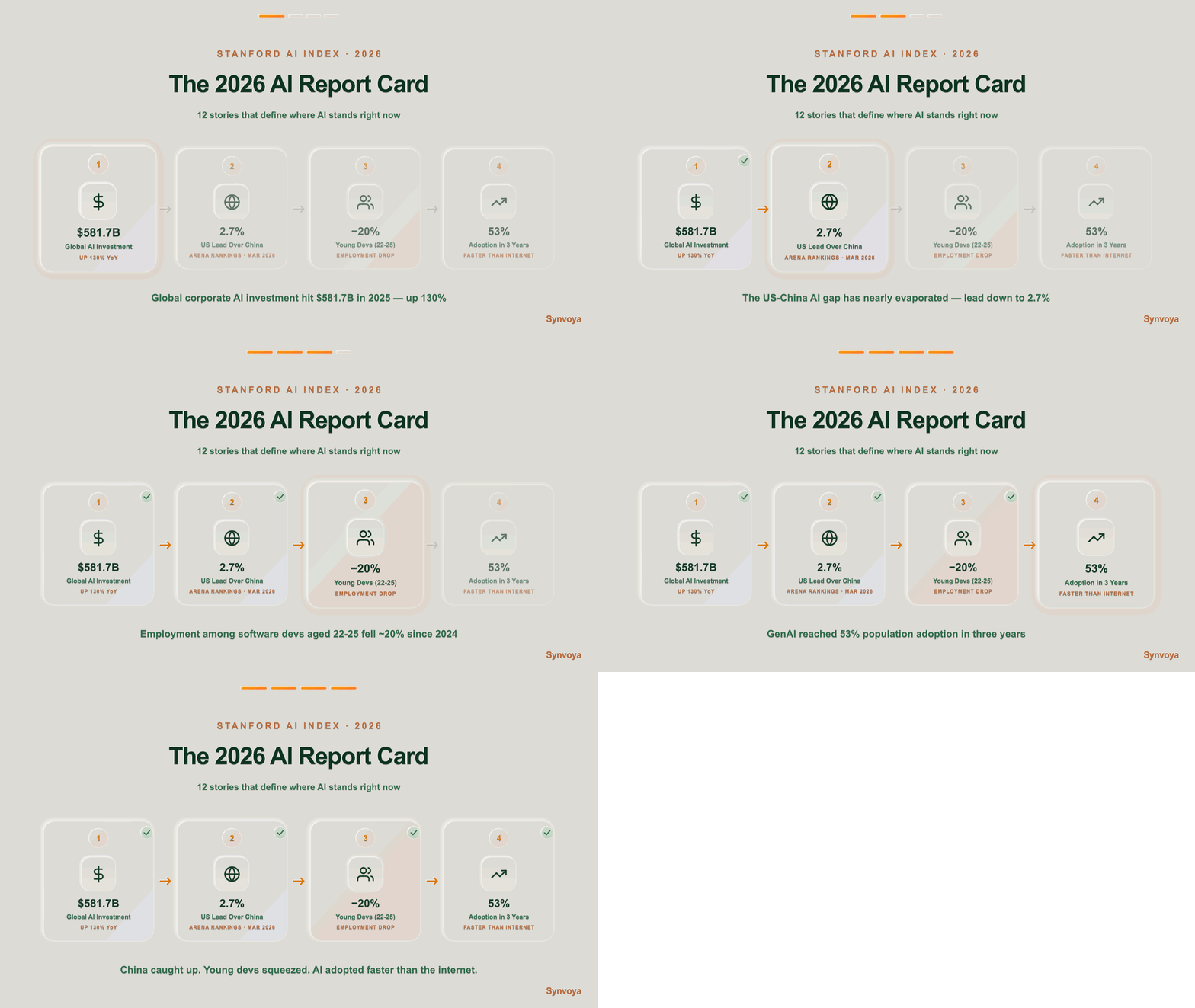
For years, the US held a commanding lead in AI model performance. That’s over. US and Chinese models have traded the top spot on Arena rankings multiple times since early 2025. DeepSeek-R1 briefly matched the best American model in February 2025, and as of March 2026, Anthropic’s top model leads by just 2.7%. The US still produces more top-tier models and higher-impact patents, but China leads in publication volume, citations, total patent output, and industrial robot installations — 295,000 units deployed in 2024 vs. America’s 34,200. It’s no longer a two-horse race either: South Korea now files more AI patents per capita than any other country, and 44 nations have state-backed supercomputing clusters.
INVESTMENT · $581.7 Billion and Counting
Global corporate AI investment hit $581.7 billion in 2025, up 130% from the prior year. Private investment alone reached $344.7 billion. The US dominates: $285.9 billion in private AI investment — 23 times more than China’s $12.4 billion. But that private number understates China’s real spending. Between 2000 and 2023, Chinese government guidance funds deployed an estimated $912 billion across industries including AI. The US also led in entrepreneurial activity with 1,953 newly funded AI companies in 2025 — more than 10 times the next closest country.
WORKFORCE · Young Developers Are Getting Squeezed
The disruption everyone warned about is here — and it’s hitting the youngest workers first. Employment among software developers aged 22-25 has dropped nearly 20% since 2024, even as headcount for older developers continues to grow. The same pattern is showing up in customer service and other AI-exposed roles. Meanwhile, AI is boosting productivity by 14% in customer service and 26% in software development, but gains disappear in tasks requiring more judgment. Firm surveys indicate executives plan to accelerate cuts. Translation: the disruption is targeted and just beginning.
ADOPTION · Faster Than the PC. Faster Than the Internet.
Generative AI reached 53% population adoption within three years — faster than the personal computer or the internet. But adoption varies wildly by country and correlates with GDP per capita. Singapore leads at 61%, UAE at 54%. The US ranks 24th at 28.3%. The estimated value of generative AI tools to US consumers reached $172 billion annually by early 2026, with the median value per user tripling between 2025 and 2026. Organizational adoption hit 88%. Four out of five university students now use generative AI.
BENCHMARKS · Gold-Medal Math, Can’t Tell Time
AI capabilities are expanding unevenly. Frontier models now meet or exceed human performance on PhD-level science questions, multimodal reasoning, and competition mathematics. On SWE-bench Verified (a coding benchmark), performance went from 60% to near 100% in a single year. AI agents handling cybersecurity challenges solved problems 93% of the time, up from 15% in 2024. On Humanity’s Last Exam, the top model went from 8.8% to over 50% accuracy. But AI still can’t reliably tell time, generate coherent video, manage multi-step planning, or conduct financial analysis. Robots succeed at only 12% of real household tasks like folding clothes or washing dishes.
ENVIRONMENT · The Carbon and Water Bill
AI’s environmental footprint is ballooning. Grok 4’s estimated training emissions hit 72,816 tons of CO2 — equivalent to driving 17,000 cars for a year. AI data center power capacity reached 29.6 GW, roughly what it takes to power all of New York state at peak demand. Annual GPT-4o inference water use alone may exceed the drinking water needs of 12 million people. For perspective, the cumulative power demand of all AI systems is now comparable to the national electricity consumption of Switzerland or Austria.
TRANSPARENCY · The Most Powerful Models Are the Most Opaque
The companies building the most capable AI models are sharing less about how they work. The Foundation Model Transparency Index dropped from 58 to 40 points. Google, Anthropic, and OpenAI have all stopped disclosing dataset sizes and training duration for their latest models. 80 of the 95 most notable models launched last year were released without their training code. Meanwhile, AI industry representatives have tripled their presence at congressional hearings since 2017, while neutral academic witnesses have plummeted. More than 90% of all notable AI models are now created by private companies.
TALENT · America’s Draw Is Fading
The US is home to the most AI researchers and developers in the world, but the pipeline is drying up. The number of AI scholars moving to the United States has dropped 89% since 2017 — and 80% in the last year alone. This is happening as AI companies race to scale and the demand for talent has never been higher. The implications for long-term US competitiveness are significant: if the talent stops coming, the models stop leading.
PUBLIC SENTIMENT · Optimistic and Terrified, Simultaneously
Globally, 59% of people feel optimistic about AI’s benefits (up from 52%), while 52% say the technology makes them nervous. Americans are more skeptical than most: only 33% expect AI to improve their jobs (vs. 40% globally), and the US reported the lowest trust in its own government to regulate AI among all surveyed countries — just 31%. People are simultaneously adopting AI at record speed and deeply uneasy about what it means for their livelihoods.
SCIENCE · AI Is Becoming a Discovery Engine
AI is moving beyond being a research tool and becoming an engine of scientific discovery. AI-related publications in the natural, physical, and life sciences all increased 26-28% year over year, with over 80,000 papers in 2025. For the first time, AI ran a full weather forecasting pipeline end-to-end — taking raw meteorological data and outputting predictions. Astronomy built its first foundation model, automating observations across 10 telescopes. But the quality question lingers: one researcher noted the boom is “happening too fast, without giving scientific norms time to adjust.”
HEALTHCARE · Your Doctor’s New Assistant
AI-powered clinical note generation saw widespread adoption in 2025. Physicians reported up to 83% less time spent writing notes and significant reductions in burnout. But beyond documentation, the evidence base is thin. A review of 500+ clinical AI studies found nearly half used exam-style questions instead of real patient data — only 5% used actual clinical data. Digital twins (computational representations of individual patients) are a growing area, with publications rising from near zero in 2015 to 372 in 2025.
EDUCATION · Everyone’s Learning, Nobody’s Teaching It
Four out of five US high school and college students now use AI for school-related tasks, but formal education hasn’t caught up. Only half of middle and high schools have AI policies, and just 6% of teachers say those policies are clear. Outside the classroom, professionals at every career stage are picking up AI skills — both soft skills like prompting and technical skills like AI engineering. The UAE, Chile, and South Africa are learning AI engineering skills fastest globally.
Source: Stanford HAI 2026 AI Index Report — hai.stanford.edu/ai-index/2026-ai-index-report
Follow Synvoya for daily AI news summaries — quick reads, no fluff.