OpenAI Killed Sora — $1M/Day Burn, 500K Users, and Disney Found Out an Hour Before Everyone Else
TL;DR
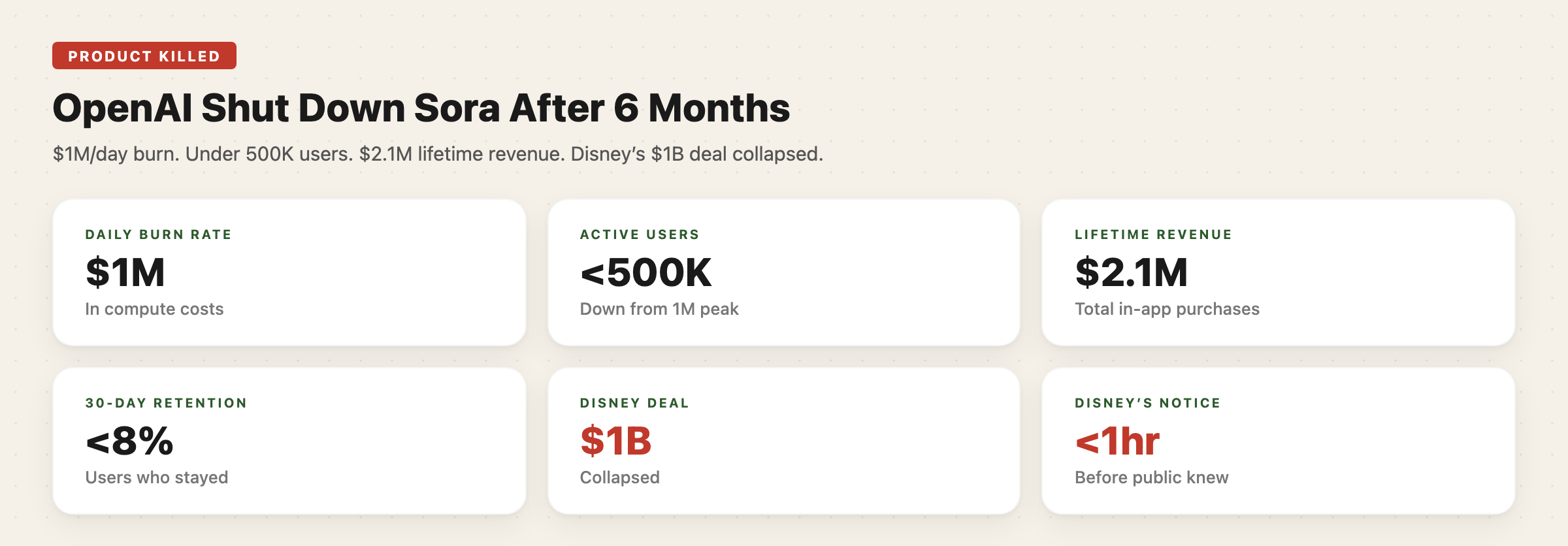
OpenAI shut down Sora, its AI video generation app, just six months after launch. It was burning roughly $1 million per day in compute costs, had fewer than 500,000 active users, and generated only $2.1 million in total lifetime revenue. Disney — which had committed $1 billion and licensed 200+ characters — found out less than an hour before the public announcement. The freed compute is being redirected to enterprise tools and OpenAI’s next-gen language model ahead of a planned IPO.
What Happened
On March 24, OpenAI posted a brief farewell on X: “We’re saying goodbye to Sora.” No detailed explanation. The app shuts down April 26, and the API follows on September 24.
A Wall Street Journal investigation revealed the real story. Sora launched as a standalone app in September 2025 after months of hype. Users peaked at roughly one million, then collapsed to under 500,000. The early virality — people generating videos of Mario, Pikachu, and other copyrighted characters — never converted to retention. The 30-day retention rate was under 8%.
Meanwhile, each 10-second video clip required about 40 minutes of parallel processing across four GPUs, costing approximately $1.30 per GPU. Daily operating costs hit roughly $1 million. Over its entire lifetime, in-app purchases generated just $2.1 million — meaning Sora burned through more in two days than it earned in its entire existence.
The timing was driven by competitive pressure. At an internal all-hands on March 16, OpenAI’s Applications CEO Fidji Simo called Anthropic a “wake-up call.” Claude Code was eating into OpenAI’s enterprise market. Anthropic’s annualized revenue hit $19 billion, with 80% from enterprise clients. OpenAI’s enterprise revenue sat at roughly $10 billion of its $25 billion total. Simo wrote in an internal memo that the company was “spreading its energy across too many applications and technology stacks.”
The biggest casualty was the Disney partnership. In December 2025, Disney signed a three-year licensing deal allowing 200+ characters from Disney, Marvel, Pixar, and Star Wars to appear in Sora. Disney also planned a $1 billion investment in OpenAI. They learned the app was dead less than an hour before the public did. The deal collapsed. A Disney spokesperson said they “respect OpenAI’s decision to exit the video generation business.”
The Numbers
| Metric | Value |
|---|---|
| Time live (standalone app) | ~6 months |
| Peak users | ~1 million |
| Users at shutdown | <500,000 |
| Daily burn rate | ~$1 million |
| Lifetime in-app revenue | $2.1 million |
| January 2026 revenue | $367,000 (down 32% from Dec) |
| 30-day retention rate | <8% |
| Cost per 10-sec clip | ~$5.20 (4 GPUs × $1.30) |
| Disney investment (collapsed) | $1 billion |
| Disney characters licensed | 200+ |
| Notice to Disney before public | <1 hour |
| App shutdown date | April 26, 2026 |
| API shutdown date | September 24, 2026 |
Who’s Involved
OpenAI — Made the kill decision. Redirecting freed compute to next-gen language model (internally code-named “Spud”) and enterprise productivity tools ahead of a potential IPO.
Disney — Had committed $1 billion and 200+ character licenses. Found out less than an hour before everyone else. Partnership is now “effectively dormant.”
Anthropic — The competitive pressure that forced the decision. Claude Code was winning enterprise developers. Anthropic’s $19B annualized revenue (80% enterprise) vs. OpenAI’s $10B enterprise share of $25B total.
Fidji Simo — OpenAI’s Applications CEO who called Anthropic a “wake-up call” and pushed for focus.
Why It Matters
This is the clearest signal yet that the AI video hype cycle has hit a wall — at least at the consumer level. Sora wasn’t killed because the technology was bad. It was killed because the economics didn’t work. Video generation devours GPU resources at a rate that text-based AI doesn’t, and consumers weren’t willing to pay enough to cover the cost.
The deeper story is about strategic focus. OpenAI was spreading itself across video, browsers (Atlas), consumer hardware (with Jony Ive), robotics, e-commerce, and advertising — all while Anthropic quietly focused on enterprise developers and won. Sora’s death is a correction: OpenAI is choosing the revenue-generating enterprise race over flashy consumer experiments.
For anyone building AI products, the lesson is stark: viral demos don’t equal sustainable businesses. Sora had the most impressive demo in AI history and still couldn’t survive contact with real users and real economics. Ships that don’t generate revenue get sunk.
Follow Synvoya for daily AI news summaries — quick reads, no fluff.